Ready to Schedule?
Save time by selecting your own appointment slot through our secure scheduling portal.


Medically reviewed by The Miller Vein Team
Medically reviewed by the Miller Vein clinical team. Last updated April 2026.
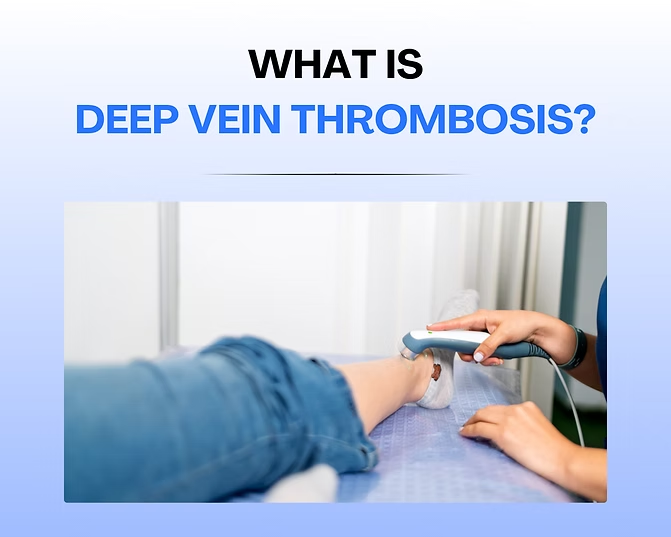
Deep vein thrombosis (DVT) is a blood clot that forms in a deep vein, most often in the calf, thigh, or hip. DVT is a serious condition because a piece of the clot can break loose and travel to the lungs, where it can block blood flow and become life-threatening.
Up to 900,000 Americans are affected by venous thromboembolism each year, and an estimated 60,000 to 100,000 die from it (CDC).
DVT happens when a clot forms inside one of the deep veins that carry blood back to the heart, usually in the lower leg, causing swelling, pain, warmth, and redness in one leg.
The most serious risk of DVT is pulmonary embolism (PE), which occurs when part of the clot breaks free and lodges in the arteries of the lungs. The CDC states that DVT does not cause heart attack or stroke in the standard way those events occur; the primary life-threatening complication of DVT is pulmonary embolism.
Important: About half of people with a DVT have no symptoms at all (CDC). An ultrasound is the only reliable way to confirm or rule out a clot.
Miller Vein is an independent, physician-owned vein practice focused exclusively on venous disease for nearly 20 years, caring for more than 48,000 patients across Southeast and West Michigan. We can perform a DVT ultrasound in our office, usually the same day you call.
If confirmed, we coordinate next steps immediately, referring you to the appropriate setting for anticoagulation therapy. If ruled out, in many cases the symptoms trace back to chronic venous insufficiency or varicose veins, which Miller Vein treats non-surgically in a single 15-minute in-office procedure.
Call Miller Vein at 877-432-2184 or schedule online here.
No. A DVT clot can cause a pulmonary embolism, not a stroke, except in rare specific cardiac conditions.
Miller Vein offers DVT ultrasounds at every location. Call 877-432-2184 or book online here.
Centers for Disease Control and Prevention – About Venous Thromboembolism; Cleveland Clinic – Deep Vein Thrombosis (DVT); Mayo Clinic – Deep Vein Thrombosis: Symptoms and Causes; National Heart, Lung, and Blood Institute – Venous Thromboembolism.
Prefer a call? Fill out the form below, and our team will reach out to help you coordinate your visit.
"*" indicates required fields
Save time by selecting your own appointment slot through our secure scheduling portal.
