


 Browse All Of Our Latest Insights
 Ready to Schedule?
Save time by selecting your own appointment slot through our secure scheduling portal.


If you have been living with lipedema, chances are you have already been told the wrong thing at least once. Eat less. Exercise more. Lose weight. But if you have tried all of that and your legs remain disproportionately large, tender, and painful, it is not because you are not trying hard enough. It is because lipedema does not respond to conventional weight loss approaches.
Lipedema is a distinct medical condition that requires specialized treatment. At Miller Vein, we offer dedicated lipedema care through our on-site Certified Lymphedema Therapy program, making us the first and only vein clinic in Michigan to provide this level of integrated, expert care under one roof. Our team understands lipedema, takes it seriously, and builds individualized treatment plans designed to reduce pain, manage progression, and meaningfully improve quality of life.
You can learn more about lipedema on our condition overview page.
We see patients at clinics throughout Michigan in Auburn Hills, Dearborn, Grand Rapids, Holland, Macomb, Novi, St. Clair Shores, and Troy.
Related care such as treating lymphedema may also be recommended.
Lipedema is a chronic condition characterized by the abnormal fat buildup in the legs and sometimes the arms. This fat is structurally and biologically different from ordinary adipose tissue. It does not distribute evenly throughout the body, it does not respond to caloric restriction or physical activity the way normal fat does, and it is accompanied by pain, tenderness, and easy bruising that have nothing to do with fitness level or diet.
Because lipedema is so frequently misidentified as obesity or general weight gain, many women spend years pursuing interventions that were never going to work. Conventional weight loss treatments do not address lipedema fat. Dieting may reduce overall body weight, but it will not change the disproportionate distribution in the legs or eliminate the pain.
Effective lipedema treatment requires a care team that understands the condition’s specific pathology, recognizes the distinction between lipedema and lymphedema, and knows how to manage the progressive nature of the disease before it advances to a more complex stage. That is exactly what our Certified Lymphedema Therapists at Miller Vein are trained to provide.
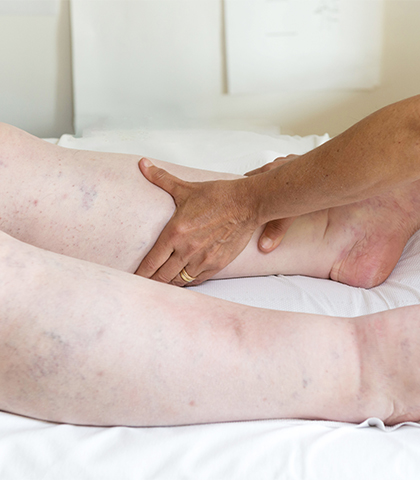
Lipedema symptoms are often dismissed or attributed to weight gain for years before an accurate diagnosis is made. Knowing what to look for, and what makes lipedema distinct from other conditions, is an important step toward getting the right care.
See insurance and payment options for details on what your plan may cover.
Symmetrical fat accumulation in both legs, typically extending from the hips down to the ankles. Unlike general weight gain, the distribution is distinctly disproportionate. The legs appear significantly larger relative to the upper body, and both sides are affected equally.
A visible boundary where the abnormal fat stops at the ankle and the feet begin, leaving the feet comparatively unaffected. This step-like transition is one of the most recognizable clinical features of lipedema and helps distinguish it from lymphedema, which typically involves the feet.
Pain and tenderness in the affected areas, even with light touch or gentle pressure. Spontaneous aching, throbbing, or a sense of heaviness in the legs is common, particularly after standing or physical activity. This pain is a hallmark of lipedema and one of the clearest distinctions from ordinary obesity, which is not inherently painful.
Easy and unexplained bruising in the affected areas, caused by the fragile, abnormal capillaries within lipedema tissue that rupture with minimal trauma.
Small nodules or lumps beneath the skin that can feel like pebbles or irregular masses, particularly noticeable in the thighs and lower legs. These nodules become more pronounced as the condition progresses through its stages.
Swelling in the affected areas, particularly later in the day or after prolonged standing, that does not fully resolve overnight. In earlier stages, this swelling is driven by fluid buildup around the abnormal fat tissue. In later stages, lymphatic involvement may add a more persistent fluid component.
Fatigue and heaviness in the legs disproportionate to the level of physical activity, which can make walking, climbing stairs, or standing for extended periods increasingly difficult as the condition advances.
If any of these symptoms sound familiar, particularly the combination of symmetrical leg heaviness, tenderness, easy bruising, and disproportionate appearance that has not responded to diet or exercise, a lipedema evaluation at Miller Vein is a worthwhile next step.

The staff was wonderful and really took my concerns and put my mind at ease. I would definitely recommend them to everyone. Staff on time, and had my ultrasound done and saw the doctor and was out of the office start to finish 90 minutes, was first visit. The Dearborn office was wonderful.
My experience was amazing. I got there a little bit early, I was taken right back. Everybody was very nice, explained everything to me as they went. I would recommend Miller Vein to anybody; they are fantastic.
The front desk personnel were very professional and welcoming. I was seen by one of the most welcoming and patient ultrasound technicians. She was very pleasant and informative. She explained every step and made me feel comfortable throughout the exam. The doctor is the reason the office is so calm and welcoming. The doctor was informative as she explained the diagnosis and plan of care needed. I would definitely refer someone in need of their services.
Very friendly staff and very thorough. They explained everything as they went through the different steps during the appointment. I felt very at ease here. I am very happy I chose them.


Chronic venous insufficiency (CVI) is frequently found alongside lipedema and can significantly accelerate its progression. When the leg veins are unable to return blood to the heart efficiently, the elevated venous pressure contributes additional fluid to the tissue, worsening the swelling, discomfort, and lymphatic burden that lipedema already creates. In some cases, the combination of untreated CVI and lipedema is what tips a patient from lipedema into the more complex combined condition of lipolymphedema.
Identifying and treating underlying vein disease is therefore an important part of comprehensive lipedema care. At Miller Vein, our board-certified vein physicians evaluate every lipedema patient for venous insufficiency and, when present, treat it with minimally invasive, in-office procedures. These quick, low-downtime venous ablation treatments reduce venous pressure in the lower leg, removing one of the key drivers of progressive fluid accumulation and giving lymphedema therapy a better foundation to work from.
This is what makes Miller Vein’s integrated model genuinely different. Most lipedema patients are seen either by a lymphedema specialist with no vascular expertise or by a vein clinic with no lymphedema program. Our patients receive both under the same roof, coordinated by a team that understands how the two conditions interact.
Our lipedema treatment program follows the same two-phase CDT framework used for lymphedema, adapted to the specific characteristics of lipedema.
The decongestive phase is the active treatment phase, focused on reducing fluid accumulation, softening any areas of early tissue fibrosis, and improving skin condition. Patients attend therapy sessions multiple times per week during this phase, with each session incorporating manual lymphatic drainage, compression bandaging applied between sessions to sustain gains, therapeutic exercise, and skin care.
The frequency of sessions during this phase and the duration of the phase itself depend on the stage and severity of the lipedema, the presence of any secondary lymphatic involvement, and the patient’s response to treatment. Your CLT will set clear expectations at the outset and adjust the plan as treatment progresses.
Once swelling has been reduced to a stable level, treatment transitions into the maintenance phase. The focus shifts from active decongestion to empowering the patient to sustain and build on the progress made in Phase One through a home-based self-management program.
The maintenance program typically includes daily compression garment use, a home exercise routine, skin care practices, and education on recognizing and responding to early signs of worsening. Our CLTs provide thorough training throughout the transition and remain available for follow-up and garment reassessment as the patient’s needs evolve.
Miller Vein offers Complete Decongestive Therapy through our Certified Lymphedema Therapy program. On-site CLT is currently delivered at our Auburn Hills location, and patients across all eight of our Michigan locations can be referred for care. As we grow our team of certified therapists, we are expanding on-site availability to additional locations. We see patients at:
Our clinics are open Monday through Friday, 7:00 AM to 5:30 PM.






We weren’t expecting this particular holiday gift, but you all went ahead and got us one anyway! Based on your reviews of our Dearborn...
Read BlogWhen we think about major health threats, we often picture sudden illnesses like heart attacks or the flu. But one of the biggest challenges...
Read BlogPrefer a call? Fill out the form below, and our team will reach out to help you coordinate your visit.
"*" indicates required fields
Save time by selecting your own appointment slot through our secure scheduling portal.
