








 Browse all of our latest insights and updates.
 Ready to Schedule?
Save time by selecting your own appointment slot through our secure scheduling portal.


Tired legs. Swollen ankles. That heavy, aching feeling that gets worse as the day goes on. These symptoms are easy to dismiss as signs of aging, a demanding job, or simply being on your feet too much. But for millions of Americans, they are the unmistakable signs of a medical condition called chronic venous insufficiency, and they are not something you should have to just live with.
Chronic venous insufficiency, or CVI, is a common but frequently overlooked condition that affects the veins in the legs. It is progressive, meaning it worsens over time without treatment. And importantly, it is very treatable when caught and addressed early.
The good news: effective care is available — explore chronic venous insufficiency treatment to see how our specialists can help.
At Miller Vein, our board-certified specialists provide expert, compassionate CVI care at clinics throughout Michigan. If your legs have been telling you something is not right, it may be time to listen.
For a closer look at this topic, our article on common CVI symptoms and what to do about them is a helpful read.
Chronic venous insufficiency is a condition in which the veins of the legs are unable to efficiently return blood back to the heart. To understand why this happens, it helps to know how the venous system is designed to work.
The veins in your legs face an uphill battle, literally. They must push blood upward against gravity, from the feet and calves all the way back to the heart. To accomplish this, the veins rely on one-way valves that open to let blood flow upward and then close to prevent it from falling back down. The rhythmic contractions of the calf muscles act as a pump with every step, helping propel blood through these valves.
When those valves weaken, become damaged, or fail to close properly, blood is allowed to flow backward, a process called venous reflux. Blood pools in the lower legs instead of returning to circulation. Over time, this pooling increases the pressure within the veins and surrounding tissue, leading to a range of symptoms associated with CVI.
CVI is not just a cosmetic problem, and it is not simply an inconvenience. Left untreated, it progresses steadily and can lead to serious complications, including venous leg ulcers, skin breakdown, lymphedema, and chronic pain. Understanding the condition and seeking appropriate care are the most important steps you can take.
CVI develops when the valves inside the leg veins are weakened or damaged. Several factors can cause or contribute to this process, including:
Depending on your evaluation, options like radiofrequency ablation may also play a role in your care plan.
Family history is one of the strongest predictors of CVI. If a parent or sibling has had varicose veins or venous disease, your risk is meaningfully elevated. The structural integrity of the vein walls and valves is largely inherited, which is why CVI and its related conditions often appear across multiple generations.
The veins and their valves naturally lose elasticity and strength over time. The cumulative wear of years of gravity, physical activity, and hormonal changes makes CVI progressively more common with age, particularly from the 40s onward.
CVI is more prevalent in women than in men. Hormones, particularly estrogen and progesterone, can relax vein walls and impair valve function. Pregnancy, menopause, hormonal contraceptives, and hormone replacement therapy are all associated with increased risk.
During pregnancy, blood volume increases substantially to support the developing baby. This added volume, combined with the pressure the growing uterus places on the pelvic veins, significantly increases venous pressure in the legs. Each pregnancy can cause or worsen CVI, and many women notice symptoms appearing or intensifying with subsequent pregnancies.
Occupations or lifestyle habits that involve long periods of standing or sitting without movement put sustained pressure on the leg veins and reduce the effectiveness of the calf muscle pump. People who spend the majority of their workday on their feet, such as nurses, teachers, and retail workers, are at particularly elevated risk, as are those in sedentary desk jobs.
A history of deep vein thrombosis (DVT) significantly increases the risk of CVI. After a DVT, the clot can damage the vein valves as it resolves, leaving them unable to function properly. The resulting valve failure leads to reflux and, over time, the development of CVI and its associated symptoms, a complication known as post-thrombotic syndrome.
CVI produces a range of symptoms that vary in severity from person to person. One of the reasons the condition is so often missed or dismissed is that many of its symptoms seem nonspecific and are easy to attribute to other causes. Understanding what to watch for is the first step toward getting the right diagnosis.

The front desk personnel were very professional and welcoming. I was seen by one of the most welcoming and patient ultrasound technicians. She was very pleasant and informative. She explained every step and made me feel comfortable throughout the exam. The doctor is the reason the office is so calm and welcoming. The doctor was informative as she explained the diagnosis and plan of care needed. I would definitely refer someone in need of their services.
What a wonderful experience. So friendly took great care of me explained what they were doing and the outcome. Resp, Annie and Mattie made my day.
The staff was wonderful and really took my concerns and put my mind at ease. I would definitely recommend them to everyone. Staff on time, and had my ultrasound done and saw the doctor and was out of the office start to finish 90 minutes, was first visit. The Dearborn office was wonderful.
Great Clinic! So glad I went. My legs feel so much better! I can already see some of the benefits and will just get better over time! The doctors and staff are so kind and friendly. Such an easy location with lots of free parking. Highly recommend!!


One of the most important and most commonly misunderstood facts about CVI is that you do not need to have visible varicose veins to have it. Many people assume that vein disease only exists when there are visible, bulging veins on the surface of the legs. This is not true.
CVI can be present and symptomatic in people with no visible varicose veins at all. The underlying valve failure and venous reflux may be occurring in deeper vessels that are not visible on the surface. Symptoms like aching, heaviness, swelling, and restless legs can all reflect CVI even in the absence of any visible vein abnormalities.
This is why a duplex ultrasound, rather than a visual examination alone, is the essential diagnostic tool for CVI. The ultrasound images the deep venous anatomy, reveals reflux that cannot be seen from the outside, and provides the information needed to properly diagnose and plan treatment for the condition.
If you are experiencing leg symptoms and have been told your legs look fine, it may be worth asking for a vein evaluation specifically.
Diagnosing CVI begins with a thorough clinical evaluation, including a review of your symptoms, medical history, and risk factors. But the cornerstone of diagnosis is a duplex ultrasound examination.
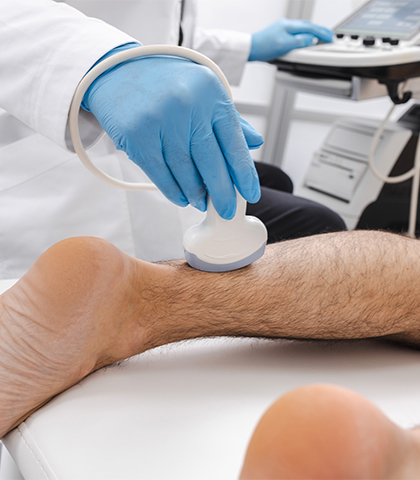
A duplex ultrasound is a non-invasive, painless imaging study that uses sound waves to visualize blood flow through the veins in real time. It allows our specialists to see both the structure of the venous system and the direction and pattern of blood flow within it. This makes it possible to identify venous reflux, map the affected veins, assess the severity of valve dysfunction, and detect any underlying deep vein abnormalities.
This information is not just important for confirming a diagnosis. It directly guides the treatment plan. Without a detailed ultrasound map of the venous system, it is not possible to know which veins are causing the symptoms or which intervention will most effectively address the root problem.
At Miller Vein, every CVI evaluation includes a comprehensive duplex ultrasound performed by our experienced vascular team. The results are reviewed directly with you so you understand exactly what is going on and what we recommend as next steps.
CVI does not stay stable. Without treatment, the condition tends to progress steadily, and the stakes get higher at each stage of advancement. Early-stage CVI involving aching, heaviness, and mild swelling is highly responsive to treatment and relatively straightforward to manage. Late-stage CVI involving skin breakdown, lipodermatosclerosis, and venous ulcers is far more complex, more painful, and more difficult to resolve.
This is why waiting is rarely the right strategy. Many people delay seeking care because their symptoms seem manageable, because they assume leg discomfort is just part of getting older, or because they think treatment is only necessary when varicose veins are visible. All of these assumptions can lead to a condition that could have been treated simply becoming a much larger problem.
If your legs are telling you something is wrong, whether through aching, swelling, heaviness, or skin changes, the right time to get evaluated is now.







Chronic venous insufficiency (CVI) is a common but often overlooked medical condition that primarily affects the veins in your legs. CVI occurs when the...
Read BlogWhen we think of knee pain, the usual culprits come to mind—arthritis, injuries, or even just aging. But did you know that poor blood...
Read BlogPrefer a call? Fill out the form below, and our team will reach out to help you coordinate your visit.
"*" indicates required fields
Save time by selecting your own appointment slot through our secure scheduling portal.
