




 Browse all of our latest insights and updates
 Ready to Schedule?
Save time by selecting your own appointment slot through our secure scheduling portal.


Sclerotherapy has been the gold standard for treating abnormal veins for decades, and for good reason. It is precise, effective, well-tolerated, and requires no downtime. Whether you are bothered by spider veins on your legs or face, dealing with reticular veins that feed visible surface clusters, or managing varicose veins and chronic venous insufficiency, sclerotherapy offers a targeted, proven solution.
At Miller Vein, sclerotherapy is used across both our medical vein treatment program and our VeinErase® cosmetic spider vein treatment program. Our board-certified vein specialists and dedicated VeinErase® providers tailor every treatment plan to the specific veins, symptoms, and goals of each individual patient.
Compare this with treating spider veins to see which fits your veins best.
Sclerotherapy, also known as endovenous chemical ablation (EVCA), is a minimally invasive vein treatment in which an FDA-approved chemical solution called a sclerosant is injected directly into an affected vein, causing it to close and eventually fade from view. The sclerosant irritates the inner lining of the vein wall, causing the walls to stick together and seal permanently shut. Once sealed, blood is naturally rerouted through the healthy veins surrounding it, and the treated vein is gradually broken down and reabsorbed by the body over the following weeks.
At Miller Vein, we use Asclera (polidocanol), an FDA-approved sclerosant with a well-established record of safety and effectiveness. Depending on the size and type of vein being treated, the medication is delivered either as a liquid solution for smaller vessels or as a foam preparation for larger or deeper veins that benefit from greater surface contact.
The procedure requires no incisions, no anesthesia beyond the very fine needle entry itself, and no downtime. Most sessions are completed in under thirty minutes, and patients walk out of the clinic and resume normal activities immediately.
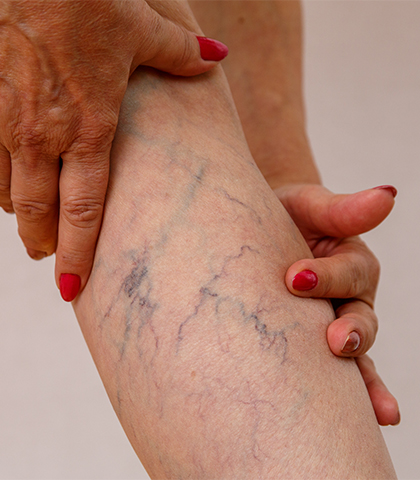
For many people, spider veins are purely a cosmetic concern with no physical symptoms at all. For others, they can cause:
Our page covering what causes spider veins has the details.
It is also worth knowing that spider veins can sometimes be an outward sign of an underlying condition, such as venous reflux disease (VRD) or chronic venous insufficiency (CVI). These conditions occur when the valves inside the veins stop functioning properly, causing blood to pool instead of flowing efficiently back toward the heart.
If you are experiencing leg pain, throbbing, heaviness, skin changes, or wounds that are slow to heal alongside your spider veins, a thorough vein evaluation is especially important. At Miller Vein, we screen for underlying vein conditions (including blood clots) at every visit to make sure your care plan addresses both the visible veins and any root causes.

The staff was wonderful and really took my concerns and put my mind at ease. I would definitely recommend them to everyone. Staff on time, and had my ultrasound done and saw the doctor and was out of the office start to finish 90 minutes, was first visit. The Dearborn office was wonderful.
Great visit to Miller Vein on 3/11. Very thorough explanation and the most wonderful tech in the world did my scans. She answered all my questions and concerns. Results of scans were provided in minutes. Would definitely return if I had a need and will refer my friends if they have a need.
The staff is so friendly. They explain well before they do anything. Dr Miller is awesome. Explains treatment and plan of care in detail. Answers all questions thoroughly. Had a very good consultation.
Highly recommend.


Not all sclerotherapy is the same. The preparation of the medication matters, and the right form depends on the size and characteristics of the vein being treated.
Liquid sclerotherapy uses the sclerosant in its standard solution form. It is most effective for small veins, particularly spider veins and fine reticular veins, where the medication makes direct contact with the vein wall and produces reliable closure. Liquid sclerotherapy is the foundation of our VeinErase® spider vein treatment program.
Foam sclerotherapy is created by mixing the sclerosant with a small amount of air or gas using a specialized technique, producing a foam consistency. Foam displaces blood within the vein rather than mixing with it, allowing the medication to maintain direct, prolonged contact with the vein wall. It also spreads along the vessel in both directions from the injection point, treating a broader segment from a single entry.
Foam sclerotherapy is used for larger varicose veins, reticular veins with significant diameter, and in ultrasound-guided procedures where treating an extended vessel segment is the goal. It produces a more robust and thorough closure in vessels that would not respond adequately to liquid injection alone.
Recovery from sclerotherapy is minimal for most patients. Here is what the days and weeks following your session typically look like.
In the first few days, mild bruising, slight redness, or small raised areas at the injection sites are all normal responses as the treated veins begin to close and the surrounding tissue responds to the sclerosant. These typically resolve within one to two weeks.
Treated veins do not disappear immediately. Over the weeks following treatment, closed veins gradually fade as the body breaks them down and absorbs the tissue. Spider veins typically begin showing noticeable fading within two to six weeks. Larger varicose veins may take somewhat longer to show visible improvement.
Some patients notice a temporary brownish discoloration at treated sites, caused by the breakdown of hemoglobin from red blood cells inside the closed vein. This typically fades over weeks to months. Wearing compression as directed and protecting treated areas from direct sun exposure during the healing period can help minimize this discoloration.
Most patients benefit from multiple sessions to achieve their best results. Your specialist will outline a realistic timeline and session plan based on your vein type and treatment goals.
Miller Vein offers both medical and cosmetic sclerotherapy at eight convenient locations throughout Michigan. We see patients at:
Our clinics are open Monday through Friday, 7:00 AM to 5:30 PM.
Whether you are seeking relief from the physical symptoms of varicose veins and CVI or looking to reduce the appearance of spider veins, sclerotherapy at Miller Vein delivers precise, proven results in a comfortable setting. Our specialists are ready to evaluate your veins, explain your options, and build a plan tailored to your goals. Schedule your consultation at Miller Vein today.







Sclerotherapy is one of the most straightforward procedures we offer, and patients consistently tell us the experience was far easier than they expected. Here is an honest walkthrough of what to expect.
There are multiple treatment options for varicose veins, and you may wonder which option will give you the best results with a comfortable experience....
Read BlogIf you are researching the cost of removing spider veins in Grand Rapids, you are asking exactly the right question before booking a consultation....
Read BlogPrefer a call? Fill out the form below, and our team will reach out to help you coordinate your visit.
"*" indicates required fields
Save time by selecting your own appointment slot through our secure scheduling portal.