










 Browse all of our latest insights and updates.
 Ready to Schedule?
Save time by selecting your own appointment slot through our secure scheduling portal.


Deep vein thrombosis often shows up as swelling in just one leg, a calf that aches when you stand, or skin that feels warm and looks red. Left alone, a clot in a deep vein won’t resolve on its own.
Miller Vein can scan you and give you an answer fast. Our DVT checks use painless ultrasound to look directly inside the deep veins of your leg, at locations across Michigan, including Auburn Hills, Dearborn, Grand Rapids, Holland, Macomb, Novi, St. Clair Shores, and Troy.
It’s often discussed alongside DVT treatment options during your evaluation.
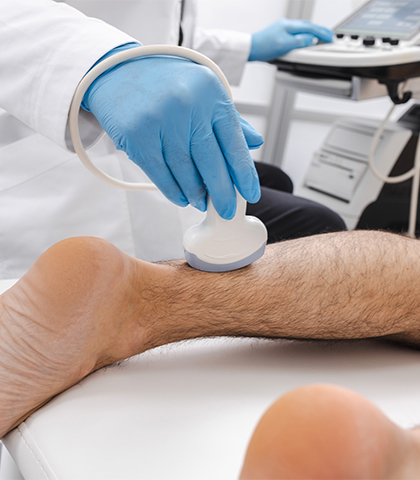
A DVT blood clot check is a focused, non-invasive evaluation designed to determine whether a deep vein thrombosis is present in the leg. It combines a brief clinical assessment with a duplex ultrasound examination, the gold standard diagnostic tool for detecting DVT, to give patients fast, accurate, actionable answers.
Our experienced vein specialists perform the evaluation, and it typically takes under an hour from the time you arrive to the time you leave with a clear picture of what is or is not happening in your leg.
Time is a meaningful factor in DVT management. The sooner a clot is identified, the sooner anticoagulation treatment can begin to prevent the clot from growing, reduce the risk of pulmonary embolism, and improve long-term outcomes. Delays in diagnosis are associated with worse outcomes and a higher risk of post-thrombotic syndrome, the chronic leg condition that can develop when DVT damages the vein valves.
If you are worried about a blood clot, the right time to get evaluated is now.

The front desk personnel were very professional and welcoming. I was seen by one of the most welcoming and patient ultrasound technicians. She was very pleasant and informative. She explained every step and made me feel comfortable throughout the exam. The doctor is the reason the office is so calm and welcoming. The doctor was informative as she explained the diagnosis and plan of care needed. I would definitely refer someone in need of their services.
The staff was wonderful and really took my concerns and put my mind at ease. I would definitely recommend them to everyone. Staff on time, and had my ultrasound done and saw the doctor and was out of the office start to finish 90 minutes, was first visit. The Dearborn office was wonderful.
I was not sure if I would like it here, and that was only because of my past experience with another clinic. This place here was very nice. They took their time with me. Made me feel very comfortable. Especially when the Doctor gave me the treatment plan, I was so happy with it. Thank you everyone at Miller Vein clinic you’re the best.


DVT symptoms can range from very clear to surprisingly subtle. Some patients present with a classic combination of signs that immediately raises concern. Others notice only mild, intermittent discomfort that they have been attributing to something else for days. When in doubt, getting evaluated is always the right decision.
DVT symptoms almost always affect only one leg. When both legs are swollen, other conditions such as venous insufficiency or lymphedema are more likely causes. However, asymmetric symptoms in one leg warrant prompt DVT evaluation.
If you are experiencing any leg symptoms in combination with any of the following, your risk of DVT is meaningfully elevated and a same-day evaluation is particularly important:
If you develop any of the following symptoms, call 911 or go to your nearest emergency room immediately. These may indicate a pulmonary embolism, a life-threatening emergency:







Our DVT evaluation process is designed to be thorough, efficient, and as comfortable as possible, given the anxiety that often accompanies concerns about a possible blood clot.
When you are worried about a blood clot, where you go for evaluation matters. Here is why patients choose Miller Vein for DVT checks.
Contact Us
Emergency departments are the traditional option for DVT evaluation, but they involve lengthy waits, high stress, and high cost. Miller Vein offers a focused, vein specialist-led DVT evaluation in a calm, comfortable clinic environment, with results the same day.
Our DVT evaluations are performed by physicians and specialists whose entire clinical focus is on the venous system. They read vein ultrasounds every day, recognize the full range of venous presentations, and understand the clinical context of DVT in a way that a generalist cannot match.
If a clot is found, we do not simply hand you a report and send you on your way. We coordinate your care actively and ensure you are connected with appropriate treatment without unnecessary delay. Speed matters in DVT management, and we take that seriously.
With eight clinic locations spread across the state, there is a Miller Vein clinic convenient to you. You do not have to travel far or navigate a large hospital system to get the evaluation you need.
Whether the result is reassuring or requires urgent follow-up, you will leave your appointment knowing what is going on with your leg. That certainty has real value when you are anxious about your health.
Medically reviewed by the Miller Vein clinical team. Last updated April 2026. Deep vein thrombosis (DVT) is a blood clot that forms in a...
Read BlogWhen we think of athletes, we picture strength, speed, and health. But even the fittest athletes can face hidden health risks, especially when it...
Read BlogPrefer a call? Fill out the form below, and our team will reach out to help you coordinate your visit.
"*" indicates required fields
Save time by selecting your own appointment slot through our secure scheduling portal.