Ready to Schedule?
Save time by selecting your own appointment slot through our secure scheduling portal.


Medically reviewed by Miller Vein
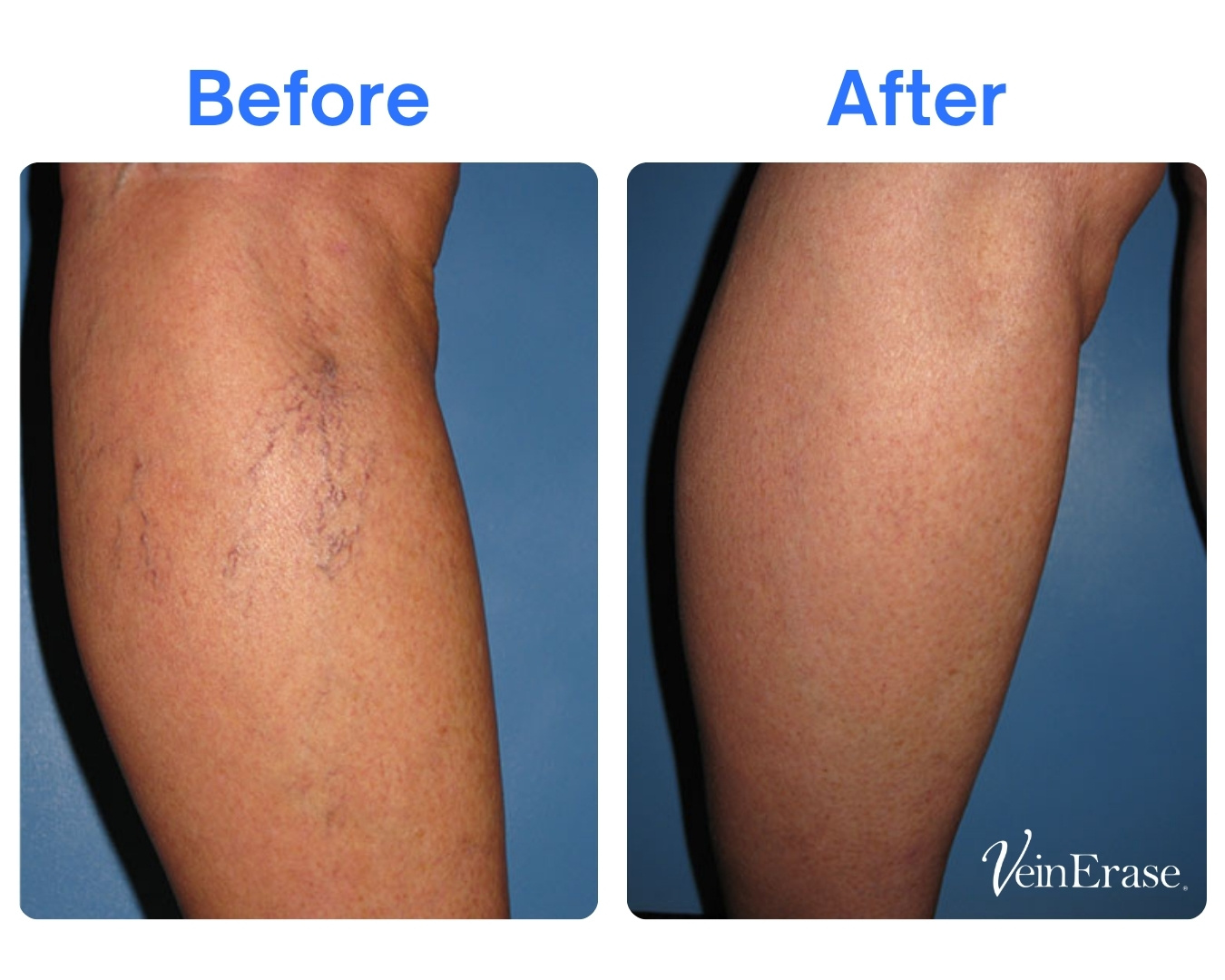
Spider veins, also known as telangiectasias, are tiny, red, purple, or blue blood vessels that appear near the surface of the skin.
They can show up anywhere on the body but are most often seen on the legs and face.
The next step is simple: explore options for treating spider veins and get answers about your veins.
They are small, thin blood vessels, usually red, blue, or purple, that look like spider webs or tree branches.
These veins are less than 1 mm in diameter and sit just beneath the surface of the skin.
Though they can form from either arteries or veins, spider veins on the legs are usually connected to the venous system.
A variety of factors may lead to the development of spider veins, including:
VeinErase® is a trademarked method of treating spider veins only offered by Miller Vein.
One team member is focused on treating the spider veins, while another team member is focused strictly on keeping you comfortable.
The most common method of treatment used during VeinErase® is sclerotherapy. A medication is injected directly into vessels to close spider veins.
Sclerotherapy is considered the gold standard for treatment of larger spider veins on the legs and hands.
A commonly used treatment for smaller leg veins and veins on the face and hands is VeinGogh™. It delivers radiofrequency energy through an ultra-fine insulated needle to heat the affected blood vessels.
The sides of the blood vessel stick together then disappear. The ultra-fine needle allows for precise, accurate treatments, even in hard-to-treat areas, such as the nose and cheeks.
“I recently had VeinGogh™ treatment to take care of spider veins on my nose and cheeks. I could not be more pleased with the results and was pleasantly surprised on how quick and easy the procedure is.” — M.S., VeinErase® Patient
The exact reason spider veins form isn’t fully understood.
In some cases, they develop when small veins become weak and widen. This can happen even without any serious underlying vein disease.
Some theories suggest that inflammation or a lack of oxygen in tissues may cause the tiny vessels to form or expand.
While some people only notice spider veins because of how they look, others may feel:
More than half of people with spider veins report having at least one of these symptoms.
The appearance of spider veins can impact self-esteem and confidence. A major survey found that women were more bothered by spider veins on their legs than any other cosmetic issue.
As a result, treatment demand is on the rise, even when spider veins don’t cause physical symptoms.
One common misperception of spider vein treatment is that it’s very painful. Everybody experiences pain differently, but, for the most part, our patients are very comfortable.
Miller Vein happens to be the only vein clinic that offers cryotherapy during the procedure.
This is a method of cooling the skin to a point where it offers a pseudo-anesthetic response. And, as a result, you’ll experience less pain.
After a spider vein treatment, there is no downtime. You can resume normal activity right away.
Spider veins can sometimes be an early indicator of a deeper problem known as chronic venous insufficiency (CVI), particularly if you’re experiencing other symptoms, such as:
A dense collection of spider veins around the ankle is a sign of severe vein disease. This is called corona phlebectatica, and if you see these veins it’s definitely time to see a vein specialist.
Prefer a call? Fill out the form below, and our team will reach out to help you coordinate your visit.
"*" indicates required fields
Save time by selecting your own appointment slot through our secure scheduling portal.
